After a banner year for bonds, strategic opportunities emerge

Fixed income markets enter 2026 navigating structural shifts in fiscal policy and a blurring line between developed and emerging economies. Explore how selective positioning beyond traditional corporates and quality-focused strategies in below investment-grade sectors may support income and diversification despite tight spreads.
Last year delivered strong returns across fixed income markets. As we enter 2026, structural shifts – from fiscal policy dominance to blurring developed/emerging markets distinctions – will reshape opportunities. While credit spreads remain tight, selective positioning across diverse credit sectors may enhance income and portfolio resilience in this evolving landscape.
Key takeaways:
- Fiscal policy now drives markets as government spending overtakes central bank actions in shaping yield curves.
- Economic resilience supports credit despite tight valuations; focus on higher-quality below investment-grade sectors for enhanced income.
- Extending beyond traditional corporate bonds may add more attractive opportunities and diversify risk exposures.
- Emerging and developed markets distinctions are blurring, favoring sectors isolated from sovereign volatility.
2025 performance sets a strong foundation
Despite early concerns over tariffs, 2025 proved exceptional for bonds. Falling rates and tightening spreads drove all major categories above 5% returns, with emerging markets leading at 14.3%. Fourth quarter gains were more modest but broadly positive, setting a solid foundation for the year ahead.
Four themes are shaping our approach
Four distinct forces are reshaping fixed income markets. The table below summarizes how we’re translating each theme into actionable portfolio strategy.
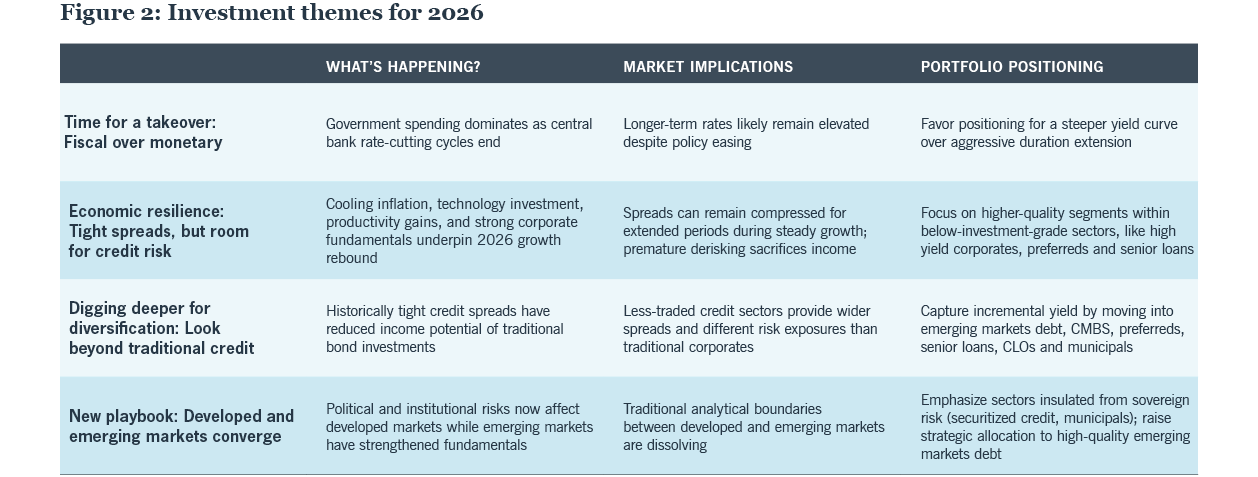
Time for a takeover: Fiscal over monetary
Central banks are nearing the end of rate-cutting cycles, and fiscal policy now dominates. Elevated deficits, demographic pressures, defense spending, industrial policy and green energy commitments will influence growth, inflation and yield curves across developed markets.
Large-scale government borrowing risks can push longer-term rates higher, particularly given already-elevated debt levels. Rather than extending portfolio duration aggressively, we favor positioning for moderately steeper yield curves by underweighting longer-duration bonds.
Economic resilience: Spreads tight, but room for credit risk
Our constructive global growth outlook remains intact – no recession is expected medium-term. Across developed markets, we expect faster growth in 2026 than 2025. We forecast U.S. GDP growth of 1.5% in 2025 (better than earlier estimates due to slower pass-through of tariffs) and 2.0% in 2026. Core PCE inflation moderates to 2.5%. Technology spending, accounting for roughly 20% of 2025 GDP growth, stays elevated as AI adoption boosts productivity. Supported by healthy balance sheets, corporate fundamentals remain strong.
However, valuations are rich. Credit spreads – measuring extra income for credit risk – sit near historical lows. Spreads have remained below average for extended periods since 2012, interrupted only by brief volatility spikes (Figure 3). Derisking prematurely may sacrifice the income advantage credit sectors provide.
We balance tight valuations against income needs by favoring higher-quality segments of below investment-grade markets: BB and B rated high yield corporates, senior loans and preferred securities. This approach captures enhanced yield while maintaining moderate overall risk, avoiding the most vulnerable CCC rated segments.