How AI Is Reshaping Credit Markets and What It Means for Dutch Pension Funds

Artificial intelligence is driving one of the largest investment cycles in recent history. Technology firms, semiconductor manufacturers, data centre operators, utilities and communications companies are committing hundreds of billions of dollars to build the infrastructure required to support AI. Much of this investment is being financed through the investment-grade corporate bond market. As a result, AI-related issuers are becoming an increasingly important part of the global credit universe.
For Dutch pension funds, this trend matters not because it changes pension regulation or liability measurement directly, but because it is reshaping the composition of the global credit markets in which they invest. As AI-related companies issue more debt and grow within investment-grade benchmarks, they are becoming a larger driver of portfolio risk, credit-market behaviour and long-term investment outcomes.
Why pension investors should care
A key theme emerging from the AI investment cycle is concentration.
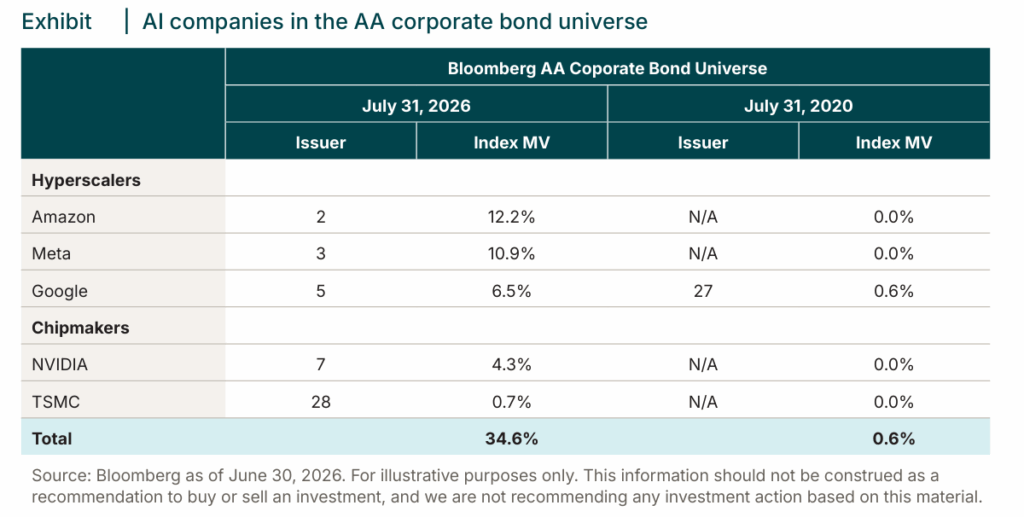
By mid-2026, AI-related issuers represented more than one-third of the Bloomberg AA Corporate Bond Index, compared with almost no representation six years earlier. Technology firms, hyperscalers and semiconductor companies have become some of the largest issuers in high-quality credit markets.
For pension investors, changes in the structure of a market can be just as important as changes in interest rates. As certain sectors become more dominant, developments affecting those issuers can have a larger influence on benchmark returns, spread movements and portfolio risk characteristics.
This is particularly relevant for Dutch pension funds operating under the Wet toekomst pensioenen (WTP). While the new framework places greater emphasis on participant outcomes and capital-market returns, risk management remains central. Matching portfolios, fixed income allocations and credit mandates continue to play an important role in generating stable returns and controlling funding risk. Understanding how benchmark composition evolves is therefore an increasingly important governance issue.
A lesson from history
The idea that market structure can influence pension outcomes is not new.
In 2012, several major global banks lost their AA credit ratings. Because these institutions represented a substantial portion of the AA credit market, their downgrades changed the composition of the benchmark itself. Pension investors experienced changes in discount curves and funding metrics that were driven not by benefit changes or government bond yields, but by changes in the underlying corporate bond universe.
The AI investment cycle is very different from the banking sector prior to the financial crisis. Nevertheless, the lesson remains relevant: when a small group of issuers becomes a dominant part of a benchmark, changes in their credit quality can have broader implications than investors may initially expect.
What could happen next?
The future impact of AI on credit markets remains uncertain. However, several plausible scenarios deserve consideration.
Scenario 1:
AI delivers a productivity revolution
In the most optimistic scenario, AI investments generate substantial economic value. The companies funding large-scale investments in data centres, semiconductors and digital infrastructure see earnings growth comfortably outpace increases in debt.
Under this outcome, many AI-related issuers retain exceptionally strong credit profiles while becoming an even larger share of global credit benchmarks. Credit spreads could remain tight and default risk low.
For Dutch pension funds, the risk may not be deteriorating credit quality but increasing concentration. Global credit portfolios could become increasingly dependent on a relatively small group of large U.S. technology companies. Trustees and investment committees may therefore need to consider whether market-cap weighted benchmarks continue to provide sufficient diversification or whether greater issuer and sector limits are warranted.
Scenario 2:
Investment continues but returns disappoint
A more nuanced outcome is that AI proves valuable but less transformative than current expectations suggest.
Companies continue investing heavily to remain competitive, but profitability does not fully justify the scale of capital expenditure. Debt issuance increases, leverage rises and investors begin demanding greater compensation for credit risk, even though issuers remain investment grade.
For Dutch pension funds, this could have both positive and negative implications. Higher spreads would increase expected future returns for credit investors and improve reinvestment opportunities. However, portfolio volatility could rise and benchmark performance could become more sensitive to issuer-specific developments.
This scenario would also place a premium on active credit management. As differences emerge between AI winners and losers, issuer selection may become more important than broad sector allocation.
Scenario 3:
An AI credit correction emerges
The most significant risk scenario would involve a broader deterioration in the creditworthiness of AI-related issuers.
History shows that periods of intense investment can sometimes lead to overcapacity, weaker profitability and credit-rating pressure. If a meaningful number of large AI-related companies were downgraded, the impact could extend well beyond the affected issuers themselves.
Changes in benchmark composition could trigger rebalancing across investment portfolios and alter the risk profile of major credit indices. Even without widespread defaults, spread widening and rating migration could create significant market volatility.
For Dutch pension funds, this scenario highlights the importance of stress testing. Funds should understand how concentrated their exposure is to AI-related sectors, how credit-spread shocks could affect matching portfolios and whether current risk models adequately capture structural changes in benchmark composition.
Scenario 4:
Europe benefits from the AI infrastructure build-out
A final scenario may be particularly relevant from a European perspective.
Supporting AI will require substantial investment in electricity grids, power generation, fibre networks, data centres and digital infrastructure. Many of these investments are likely to occur in Europe and may be financed by utilities, infrastructure companies and other sectors already familiar to Dutch institutional investors.
This could create attractive opportunities in European investment-grade credit, infrastructure debt and private markets. For large Dutch pension funds with established allocations to real assets and infrastructure, AI may represent not only a source of concentration risk but also a significant long-term investment opportunity.
The bottom line
The AI revolution is reshaping more than technology. It is changing the structure of global credit markets and creating new forms of concentration risk that institutional investors must understand. As AI-related issuers become a larger component of investment-grade bond markets, developments affecting those companies will increasingly influence benchmark behaviour, portfolio returns and overall risk exposure.
For Dutch pension funds, the key question is not whether AI succeeds or fails. Rather, it is how the growing influence of AI-related issuers changes the characteristics of the credit markets on which long-term investment strategies depend. Alongside interest-rate risk, inflation and market volatility, the evolving composition of the investment-grade universe may become an important new consideration for pension risk management in the years ahead.
Unless otherwise specified, the information and opinions presented or contained in this document are provided as of September 2026. It should be understood that subsequent developments may affect the information contained in this document materially, and MIM shall not have any obligation to update, revise, nor affirm. For additional legal and regulatory disclosures including other cross border information, please refer to www.metlife.com/investments/