Late-Cycle Credit: Staying Invested, Staying Selective

A Disciplined Framework to Capture Income While Preparing for a Shift in Market Regime
Late-cycle credit markets rarely announce themselves clearly. Spreads remain tight, income is still available, and risky assets may continue to perform. Yet beneath this apparent stability, the balance is shifting: compensation is thinner, risks are more idiosyncratic, and the margin for error is narrowing.
For investors, the challenge is no longer whether to stay invested—but how.
What this paper explores
This third paper in our credit series focuses on portfolio posture in a late-cycle environment. Building on our previous analysis of risk and cycle dynamics, it provides a practical framework for navigating the current phase.
You will discover:
- Why late cycle is not the end of opportunity—but a change in its nature
- How income (carry) behaves when spreads are tight
- Why quality becomes more valuable as asymmetry builds
- How flexibility and active management can turn uncertainty into opportunity
- What typically follows late cycle—and why timing it is so difficult
Still Dancing, Closer to the Exit: Investing in Late-Cycle Credit
If the first paper of our series focused on understanding risk before embracing it, and the second on identifying the phases of the credit cycle, this paper turns to portfolio posture. Our previous analysis concluded that credit markets now exhibit the hallmarks of a late-cycle environment. The natural follow-up question is therefore practical: how should investors remain invested when income opportunities persist, but the margin for error has narrowed?
Late-cycle conditions continue to reward participation, yet increasingly penalise complacency. This is not the moment to abandon credit. It is the moment to own it more deliberately and selectively.
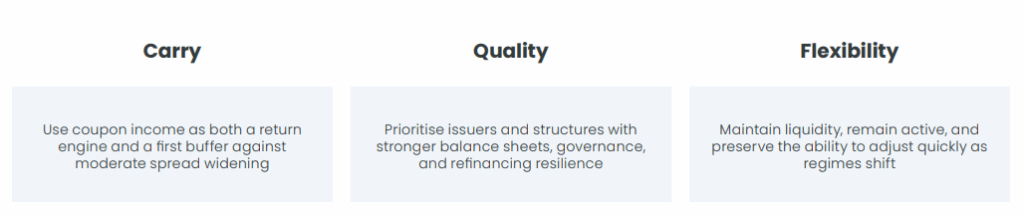
Our roadmap for late-cycle positioning
What defines a late-cycle market?
Late-cycle environments are rarely signaled by recession headlines. They typically emerge while conditions still appear supportive: spreads remain tight, fund flows are positive, and equity-friendly behaviour can persist beyond what fundamentals justify. Investors continue to reach for yield, lower-quality names may continue to outperform temporarily, and technicals can create the illusion of benign risk.
The defining characteristic of this phase is not the disappearance of risk, but its mispricing. Compensation becomes thinner, while markets overlook weaker structures, rising leverage, and increasingly demanding refinancing schedules. While inflows and optimism can keep spreads compressed, they do not override fundamental credit dynamics.
Beneath a seemingly calm surface, dispersion begins to increase. Broad indices may still appear healthy, even as idiosyncratic risks multiply through documentation weakening, issuer-specific stress, or management decisions that favour shareholders over bondholders. While market access remains open, the margin for error tightens. Technicals may still dominate, but fundamentals gradually return to the centre of the story.
Late cycle should therefore not be mistaken for a lack of opportunity. Rather, the nature of opportunity changes. Beta becomes less rewarding. Carry becomes more important. Dispersion matters more. Selectivity matters most.
What comes next?
Historically, late-cycle phases tend to transition toward a period of weaker credit performance, although the timing, magnitude and nature—gradual spread widening, increased dispersion, abrupt risk-off episodes— of this adjustment can vary significantly.
The transition from late cycle is not defined by precise timing, but by a shift in the distribution of outcomes.
Historically, the next phase is a downturn, but not necessarily a disorderly or systemic sell-off. In credit markets, downturns are challenging precisely because they are difficult to anticipate, quick to unfold, and often sharp in impact. By the time consensus acknowledges the shift, spreads have typically already repriced.
The difficulty is that markets can remain in a late-cycle phase longer than fundamentals might suggest.
Supportive technicals, persistent inflows and still-open primary markets can sustain elevated valuations even as underlying vulnerabilities emerge. The turning point often comes from a trigger that had previously deemed manageable: a failed refinancing, an aggressive transaction, a downgrade, an earnings disappointment, or a liquidity shock. In credit, a full recession is not always required for spreads to widen.
In Investment Grade, however, this typically reflects a repricing of risk premia rather than a material deterioration in fundamentals.
For this reason, late-cycle investing should not be organised around a heroic attempt to call the exact peak. Few investors achieve this consistently, and fewer yet without sacrificing too much carry along the way. A more robust approach is to continue benefiting from the income still available in credit, while building portfolios that can absorb a range of outcomes, from mild repricing to more pronounced riskoff episodes when they occur.
In other words, the objective is not only to take advantage of late-cycle conditions, but to be prepared for what typically follows.
Three principles for investing in late cycle
1) Carry: getting paid to wait, but not paid to sleep
In a late-cycle environment, carry deserves more emphasis than spread optimism. While spreads may be tight, all-in yields remain meaningfully higher than in the zero-rate era. Both euro investment grade and euro high yield offer coupons that are economically significant.
This matters for two reasons. First, carry remains a direct performance engine in a market where further spread compression is likely limited. Second, it provides a buffer when spreads begin to widen. While coupons do not eliminate downside risk, they can mitigate its impact. The focus, therefore, is not on maximizing income indiscriminately, but on ensuring that income is derived from issuers likely to sustain it.
2) Quality: keeping carry, without sacrificing discipline
As asymmetry builds, quality becomes more valuable than incremental yield. During periods of widening spread, higher-quality issuers tend to reprice less severely than weaker credits. Companies with stronger liquidity, conservative leverage, durable cash flows, disciplined financial policies, and sound governance typically retain market access longer and recover confidence more quickly.
This is not the time to chase the highest headline coupon. Instead, investors should assess whether additional spread represents genuine compensation or simply temptation coupled with elevated risk.
Emphasising quality allows portfolios to continue harvesting carry while maintaining resilience.
3) Flexibility and active management: preserving optionality
Late-cycle environments reward portfolios that can adapt. Exposures should not be so static or crowded that managers become constrained by market liquidity. Liquidity should therefore be treated as a portfolio feature, not a residual outcome.
Active management becomes increasingly important as market leadership fragments. Broad stability can coexist with significant divergence at the issuer level. The ability to reduce risk, rotate toward higherquality assets, adjust exposures, and redeploy capital into dislocations transforms uncertainty into opportunity. Flexibility is not indecision; it is disciplined optionality.
Above all, late cycle is a phase where bottom-up research becomes increasingly important, although its full value typically materialises during periods of stress or downturn, when dispersion rises more meaningfully. With spreads tight, broad market direction explains less than issuer-specific resilience.
Value is generated through detailed credit analysis: business model durability, refinancing schedules, liquidity buffers, covenant structures, capital positioning, ESG risks and management incentives. In latecycle, research helps avoid complacency; in downturns, it becomes the primary driver of outperformance.
For more details, click here
