Five Forces Shaping the Data Centre Investment Landscape

From AI and cloud demand to power constraints, five structural forces are reshaping data centre investing.
Demand is accelerating. Supply is constrained. Execution is everything. For investors seeking exposure to one of real estate’s most compelling structural growth themes, data centres continue to stand out. Yet the opportunity today looks very different from even a few years ago. The sector is being reshaped by forces that are redefining risk, returns and execution, creating opportunities for investors with the expertise to navigate an increasingly complex environment.
Demand Is Still Growing, and It’s Not Only AI
While AI has dominated recent headlines, the data centre investment story extends far beyond a single technology trend. The amount of digital data created, consumed and stored globally has increased by 19,600% since 2010, underpinning a long-term secular demand trend for data centre capacity.[1] Industry forecasts suggest the sector could grow by approximately 14% annually through 2030, with global capacity approaching 200GW.
Cloud remains a significant and well-established growth engine. Hyperscale providers continue to expand their availability zones, while data sovereignty requirements are driving additional demand across European markets. On top of this foundation, AI is creating a new layer of compute demand that is accelerating infrastructure requirements across the sector.
Importantly, AI demand is not monolithic. Today’s growth is primarily driven by model training, which requires large, high-density campuses often located in markets where land and power are more readily available. Over time, however, demand is expected to shift increasingly towards AI inference, which shares many of the same locational requirements as cloud computing and is likely to reinforce demand in primary and strong secondary markets.
For investors, cloud provides a relatively stable demand base, while AI adds a second layer of growth potential. Together, they create a deeper and more diversified demand profile than many other real estate sectors can offer.
Supply Remains Tight
The sector is experiencing an unprecedented supply crunch. Demand driven by cloud growth and AI adoption has outpaced the industry’s ability to build and power new facilities, pushing vacancy rates across the U.S. and Europe to historically low levels.
Data centre vacancy rates are at historically low levels
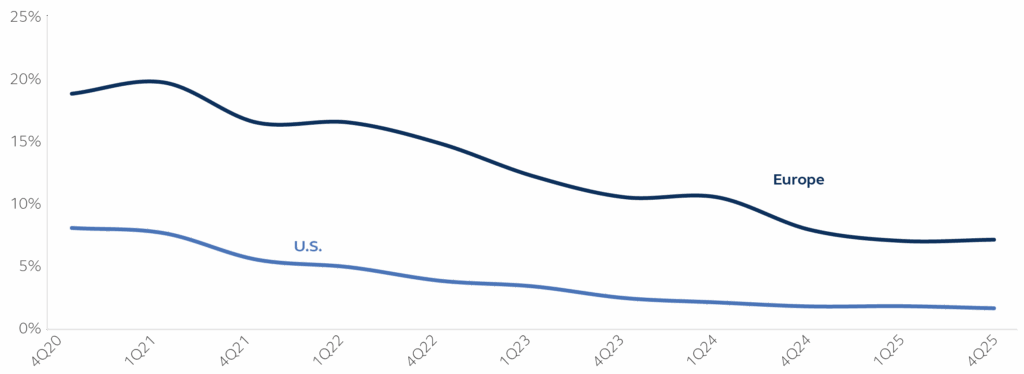
Source: datacenterHawk, CBRE, 4Q 2025
The challenge is no longer construction alone. Utility interconnection timelines can now take 24 to 48+ months, while power demand from data centres, manufacturing and electrification continues to rise.[2] Utility load growth, which averaged below 1% annually over the past two decades, could reach 15.8% over the next five years.
Power availability has effectively become a license-to-operate issue. Gartner estimates that 40% of existing AI data centres could be constrained by power availability by 2027.[3] Meanwhile, approximately US$64 billion of U.S. data centre projects were delayed or blocked between May 2024 and March 2025 due to community opposition and permitting challenges.
Lower Leasing Risk, More Infrastructure-Like Cash Flows
Pre-leasing is a defining feature of the hyperscale data centre model, but today’s commitments are longer and more secure than in previous cycles. Pre-leasing rates for new capacity typically range from 70% to more than 90%, with tenants often signing leases of 10 to 15 years or longer. Tenants are generally highly creditworthy hyperscalers including AWS, Microsoft, Google and Meta.
These characteristics increasingly give data centres the profile of contracted infrastructure rather than traditional commercial property. Long-duration leases and high tenant retention can provide greater income visibility and lower leasing risk for investors.
Capital is Moving Earlier in the Lifecycle
As off-the-shelf capacity becomes increasingly scarce, institutional capital is moving earlier into the development cycle. Investors are allocating capital at the conception, design and development stages rather than waiting for stabilised assets to become available.
Investment opportunities differ across the data centre lifecyle
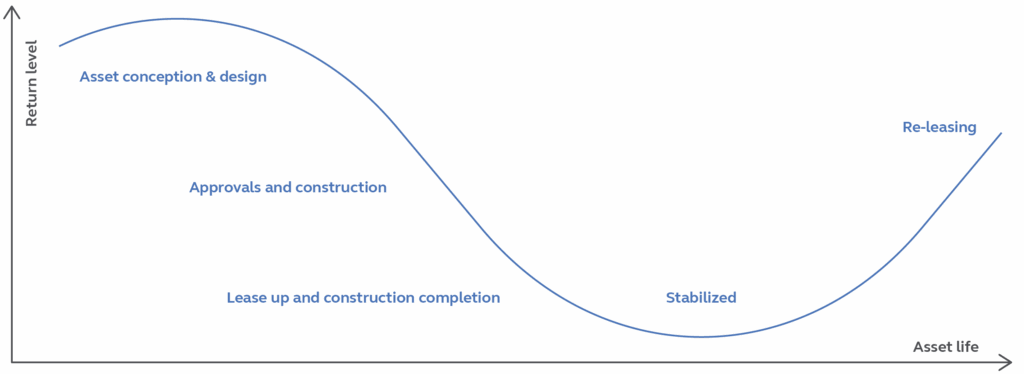
For illustrative purposes only. There is no guarantee that actual investment opportunities will have characteristics like this example. Opportunities may differ materially from that depicted above based on numerous factors.
Modern projects are significantly more capital intensive than previous generations of data centres. Power infrastructure alone can account for 40% to 50% of total project costs, while utility deposits of US$25 million to US$75 million or more are now common.
This shift creates opportunities to capture value where return potential may be highest, but it also places a greater premium on risk management, execution capability and development expertise.
Success Increasingly Depends on Power and Permits
The final and perhaps most important structural force is the growing importance of execution. In today’s environment, success is increasingly determined by an investor’s ability to secure power, obtain permits and partner with experienced developers capable of delivering complex projects.
The more difficult these hurdles become, the greater the competitive advantage for those who can overcome them. As the sector continues to evolve, the investment opportunity is no longer simply about owning data centres. It is about gaining access to the infrastructure, expertise and development capabilities required to deliver capacity into a market where demand continues to outstrip supply.
For investors, that combination of accelerating demand, constrained supply and increasingly infrastructure-like cash flows may help explain why data centres remain one of the most compelling long-term opportunities in real estate today.
Discover our approach to investing in data centres.
Principal’s Global Data Centre Team
Casey Miller – Managing Director – Portfolio Management, Private Equity Real Estate
Ian Curry – Managing Director – Portfolio Management, Private Equity Real Estate
Paul Lewis – Managing Director, European Data Centres
Sebastian Dooley – Senior Fund Manager, European Data Centres
[1] Statista, 2025
[2] CBRE, U.S. Real Estate Market Outlook 2026, 14 Jan. 2026.
[3] Gartner, Rapid Growth in Energy Consumption For GenAI Will Exceed Power Utilities’ Capacity, 12 Nov 2024.
Important information
Potential investors should be aware of the risks inherent to owning and investing in real estate, including value fluctuations, capital market pricing volatility, liquidity risks, leverage, credit risk, occupancy risk and legal risk. All these risks can lead to a decline in the value of the real estate, a decline in the income produced by the real estate and declines in the value or total loss in value of securities derived from investments in real estate. Past performance is no guarantee of future results.
This material covers general information only and should not be construed as specific investment advice, a recommendation, or be relied on in any way as a guarantee, promise, forecast or prediction of future events regarding an investment or the markets in general. The opinions and predictions expressed are subject to change without prior notice. The information presented has been derived from sources believed to be accurate; however, we do not independently verify or guarantee its accuracy or validity. Any reference to a specific investment or security does not constitute a recommendation to buy, sell, or hold such investment or security, nor an indication that the investment manager or its affiliates has recommended a specific security for any client account. 5849661