Water infrastructure: the next frontier for private infrastructure debt

Ageing networks, stretched public budgets and the rapid growth of AI are converging to create a substantial financing need. For long-term institutional investors, it is an opportunity that demands rigorous underwriting.
Public funding alone is unlikely to close the gap in water infrastructure. With government budgets under pressure in the United States and many other markets, private capital is expected to play a growing part in renewing existing systems and building new ones. Private infrastructure debt is well placed to contribute.
A system under strain
The starting point is the condition of the existing asset base. In 2025, the American Society of Civil Engineers graded US drinking water infrastructure C- and wastewater infrastructure D+. It noted that, even after funding increases, 80% of water utilities reported that revenues did not cover the cost of providing drinking water. The US Environmental Protection Agency estimates that the country needs USD 625 billion of investment over the next 20 years to replace ageing pipelines and to upgrade treatment and storage.1
Demand is also changing. US Geological Survey data for 2010 to 2020 show that crop irrigation and thermoelectric power generation each accounted for around 43% of US water use.2 Artificial intelligence now adds a new source of pressure. The United Nations estimates that global data-centre electricity consumption could almost double, from 448 terawatt-hours (TWh) in 2025 to 945 TWh in 2030, implying a need for a further 9.3 trillion litres of water.3
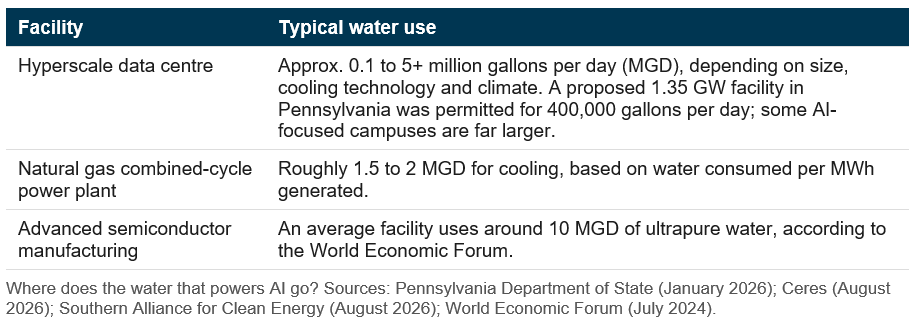
The picture is more nuanced than headline figures suggest. Water use depends heavily on cooling design: closed-loop systems, which recycle water, are more efficient than immersion systems, where more water evaporates, and facilities in cooler climates can draw on outside air. Bank of America estimates that only about 25% of the water attributable to a given data centre is consumed on site; the remainder arises in power generation and semiconductor manufacturing.4 As policymakers and the public look at total water footprints, caution is advised as estimates can at times be overstated.
Where private credit fits
Just as a data centre, its computing equipment and its power supply can be financed separately, water supply, treatment and reuse assets can be financed on their own terms, each with distinct contracts, collateral and risk profiles. The range of investable assets is broad. Some are directly linked to data centres, such as closed-loop cooling infrastructure or dedicated supply systems for data centres and co-located power plants. Others serve communities more widely, and include the treatment of brackish or otherwise non-potable groundwater; wastewater treatment and reclaimed-water systems; pipelines, pumping stations and storage; regulated water and wastewater utilities; municipal utility districts and systems serving new developments; advanced metering, leak detection and conservation projects; and capacity expansions or upgrades to existing municipal systems.
This breadth allows investors to match exposure to their return requirements. Lending to operating regulated utilities is a core opportunity. Contracted projects with limited construction or ramp-up risk sit in the core-plus category. Investors seeking higher yields may look to development projects that depend on customer connections, such as supplying a new neighbourhood with a private water source, or to smaller, unrated utilities.
The investment case
Water and wastewater assets offer the characteristics that make infrastructure attractive to institutional investors generally: an essential service, long-duration cash flows, revenues that are typically regulated or contracted, potential inflation linkage or cost pass-through, and the structural protections available in private debt, including covenants and seniority in the capital structure.
Water also has a distinguishing feature. Its direct link to the build-out of AI infrastructure offers exposure to that growth without lending against a data centre or against rapidly evolving computing technology. Where projects depend on data-centre demand, direct or indirect, diligence should focus on the identity and credit quality of counterparties, on contractual protections such as covenants and offtake agreements, and on whether the infrastructure would retain its value if the facility it serves became obsolete or went offline.
For long-term investors such as pension funds, the appeal of the segment lies in its cash-flow profile and the essential nature of the service, rather than in exposure to any single technology cycle. Even if the pace of AI investment moderates, the need to renew water and wastewater systems will remain.
Managing supply and reputational risk
Water risk is hyperlocal, shaped by the condition of individual aquifers, watersheds and utility systems. In the race to build data centres, many developers simply use the first available source or one inherited with the land. Some hyperscalers are now exploring “behind-the-meter” water systems, the counterpart of bring-your-own-power arrangements, to secure supply directly rather than through a municipal utility.
Surface water from reservoirs and rivers can be contentious and its availability unpredictable. In the US Southwest, for example, the Colorado River loses water to evaporation and supports both agriculture and households, attracting scrutiny from state and federal authorities. Underground aquifers of non-potable groundwater is a potentially better option. Such water may need extensive treatment to be drinkable, but for data-centre cooling minimal treatment is generally enough to prevent scaling, the build-up of minerals.
Due diligence should establish who else draws on the same source and how access will be monitored and controlled over time. Owners are best served by locations with groundwater conservation authorities that monitor total withdrawals from the aquifer. Where no such controls exist, unrestricted drilling can deplete an aquifer entirely, which is not sustainable.
Investors should also be clear about the legal basis for access. The project may own, lease or hold a permit to withdraw water, and where rights are owned, investors need to know whether they are transferable and enforceable, and for how long they last. Diligence should also examine how access could be lost, whether through senior claims, adjudication or curtailment, and who bears liability if a water source is contaminated.
Conclusion
Water is among a community’s most valuable resources, and the networks that deliver it and treat wastewater are ageing, whatever the trajectory of AI investment. Private infrastructure debt can help finance their renewal and expansion, but only if lenders underwrite supply risk thoroughly and back sustainable systems. Investors who combine that discipline with the familiar protections of infrastructure credit are best positioned to benefit from a long-term need.
Sources
1. US Environmental Protection Agency, 7th Drinking Water Infrastructure Needs Survey and Assessment, September 2023.
2. Medalie, L. et al., Water use across the conterminous United States, water years 2010-20, US Geological Survey Professional Paper 1894-D, 2024. https://doi.org/10.3133/pp1894D
3. United Nations scientists, “AI is threatening natural resources for billions”, June 2026.
4. Bank of America, “Data center construction creates a resource shock”, June 2026.
Unless otherwise specified, the information and opinions presented or contained in this document are provided as of September 2026. It should be understood that subsequent developments may affect the information contained in this document materially, and MetLife Investment Management shall not have any obligation to update, revise, nor affirm. For additional legal and regulatory disclosures including other cross border information, please refer to https://www.metlife.com/investments/en-nl/regulatory-disclosures/global-disclosure-statement//