Climate risk: why location matters for investors

Physical climate risks can affect far more than individual assets. From disrupted supply chains to rising operating costs, local hazards can have wider economic and financial consequences. Understanding where companies operate is therefore becoming essential to assessing their resilience. Yet geographical exposure alone does not tell the whole story: adaptation measures, operational dependencies and suppliers’ vulnerabilities also matter. Candriam explores how combining geographical data with fundamental company analysis, forward-looking scenarios and corporate engagement can help investors assess these risks. As climate pressures intensify, this broader perspective can reveal vulnerabilities that conventional financial and ESG indicators may otherwise fail to capture.
From record-breaking heatwaves and wildfires to prolonged droughts and devastating floods, the summer of 2026 brought the physical consequences of climate change sharply into focus. As these risks become increasingly immediate, their implications extend well beyond the environment, affecting economic activity, supply chains and financial markets.
For years, investors’ climate-risk assessments have focused heavily on transition risks: the regulatory, technological and market changes associated with the shift towards a low-carbon economy. As the transition progresses more slowly than anticipated, the growing physical consequences of climate change are becoming increasingly difficult to ignore. Integrating them into investment decisions is becoming essential.
Physical climate risks include acute events such as floods, wildfires and storms, alongside chronic changes such as rising temperatures, prolonged droughts and water scarcity. Their consequences extend well beyond damage to physical assets.
Consider the impact of low water levels on the Rhine: disrupted freight transport can affect entire industrial value chains, leading to supply shortages, production delays and rising costs. A heatwave, meanwhile, can reduce labour productivity, disrupt transport networks, constrain electricity generation and affect agricultural output. Because modern economies are highly interconnected, disruptions in one region can cascade across industries and borders.
Yet many conventional physical-risk models still focus primarily on direct damage to individual assets, in an approach resembling insurance risk assessment. This may overlook the indirect, cumulative and systemic consequences of climate change.
For investors, the challenge is therefore not simply to identify which assets face physical hazards, but to understand how those hazards could affect a company’s wider economic ecosystem. Are traditional financial and ESG analyses adequately capturing these consequences?
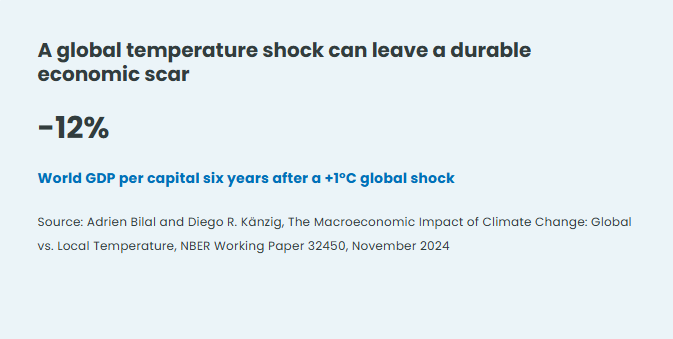
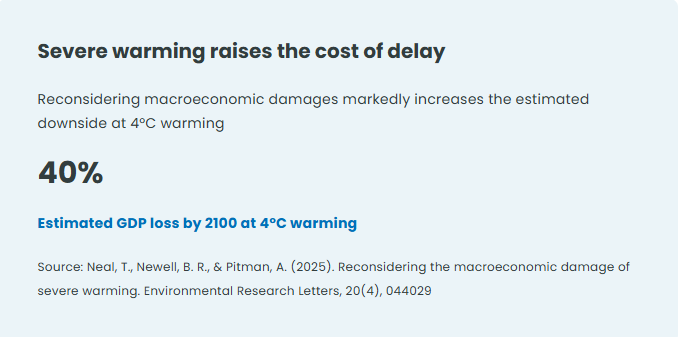
Climate risks get physical, with mounting economic, environmental and social costs
The “where”: a new dimension of ESG analysis
If physical climate risks are geographically specific but economically interconnected, assessing them requires investors to look at companies through a different lens.
Traditionally, fundamental ESG analysis has examined two key dimensions: what a company does – the sustainability characteristics and risks associated with its business activities – and how it operates, including its management of environmental and social issues.
Physical climate risks introduce an increasingly important third dimension: where.
The geographical location of a company’s assets, operations and supply chains can significantly influence its exposure to climate hazards. Two companies operating in the same sector, with similar business models, may face very different physical risks depending on where their production facilities or suppliers are located.
Consider the food and beverage industry. Understanding a company’s vulnerability to climate change requires more than analysing its direct operations. Investors also need to identify where agricultural commodities are sourced, how those regions are exposed to droughts, floods or changing precipitation patterns, and whether alternative supplies are available.
This calls for more granular, geospatial analysis, combining information on the location of corporate assets and supply chains with maps of physical climate hazards. At Candriam, we strongly believe that this location-based approach, which also underpins our biodiversity analysis, will become an essential dimension of ESG and financial analysis in an increasingly fragmented world facing growing environmental and social risks.
From geographical exposure to financial materiality
Identifying where climate risks are concentrated is an essential first step. But geographical exposure alone does not determine financial materiality.
A manufacturing facility located in a flood-prone area, for example, may have effective protective infrastructure and business continuity plans. Conversely, a company whose own facilities face relatively limited exposure may depend on a critical supplier operating in a highly vulnerable region.
Investors therefore need to combine geospatial data with a deeper understanding of companies’ operational dependencies, supply-chain concentration, risk management and adaptation strategies.
Forward-looking climate scenarios also have an important role to play. Because the pace and geographical consequences of warming remain uncertain, analysing different scenarios can help investors explore how vulnerabilities might evolve over time.
The objective is to translate physical climate exposure into potential financial consequences: higher operating costs, interruptions to production, additional capital expenditure, pressure on margins or changes in long-term growth prospects. Ultimately, these effects can influence company valuations and help investors differentiate between businesses with similar financial profiles but varying levels of climate resilience.
Assessing financial materiality therefore requires more than climate data: it calls for fundamental, company-specific research that connects physical hazards to business performance and resilience.
Building a more complete picture of corporate resilience
Integrating physical climate risks into investment decisions remains a complex exercise.
One major obstacle is data availability. Companies do not always disclose the precise location of their strategic assets, let alone the geographical footprint of their supply chains. Even when this information is available, translating physical hazards into reliable financial estimates remains difficult.
Climate-risk models are also evolving. Better geospatial datasets and more sophisticated scenarios can improve assessments, but uncertainties persist, particularly around indirect effects and the complex interactions between different economic activities.
This makes corporate engagement increasingly important. Investors need to understand not only where companies face potential vulnerabilities, but also how they identify, manage and prepare for them. Are adaptation measures integrated into strategic planning? Are critical suppliers being assessed? Is sufficient capital being allocated to strengthen operational resilience?
Ultimately, the aim is not to eliminate uncertainty, but to develop a more informed, forward-looking assessment of companies’ ability to withstand a changing climate.
Looking beyond the balance sheet
As physical climate risks become increasingly financially material, assessing corporate resilience requires investors to look beyond conventional financial and ESG indicators. Combining geographical exposure with fundamental company analysis can help reveal vulnerabilities that might otherwise remain overlooked.
In a warming world with mounting environmental and social risks, knowing where companies operate – and how prepared they are for the risks they face – is becoming an essential part of understanding their ability to generate long-term value.
Author:
Alix Chosson, Head of Climate, Transition and Impact Investing
Alix Chosson joined Candriam in 2020 as the Lead ESG Analyst for Environmental Research & Investments. She was appointed Head of Climate, Transition and Impact Investing in September 2026.
Alix has over fifteen years of experience as ESG Analyst in SRI research and portfolio management teams. She started her career at Amundi in 2010 and has more recently been sell-side ESG analyst at Natixis before joining in 2018 DNCA to contribute to the creation of the SRI team and range of funds.
Alix graduated from Science Po Lyon with a master in economics and finance in 2010. In 2011 she obtained a Master in Portfolio Management from the IAE Paris 12.