Building Europe’s Strategic Autonomy: Beyond Defence Spending

Europe’s defence spending is shifting from a discretionary expense to a structural, long-term commitment, driven by geopolitical change and evolving security needs. European initiatives are seeking to strengthen joint procurement, industrial capacity and strategic autonomy. However, higher budgets alone will not guarantee success. Supply-chain bottlenecks, labour shortages, limited factory capacity, procurement delays and political disagreements remain major obstacles. The opportunity also extends to civil aerospace and space, which are becoming increasingly important to Europe’s autonomy. For investors, selectivity remains essential, with fundamental analysis needed to identify companies able to transform sustained demand into profitable growth.
For decades, European defence budgets were treated as a discretionary line item, a peace dividend to be spent elsewhere. Russia’s invasion of Ukraine broke that assumption. The ensuing years featuring a less predictable transatlantic security relationship and the growing importance of cyber, drones and space have only reinforced that break.
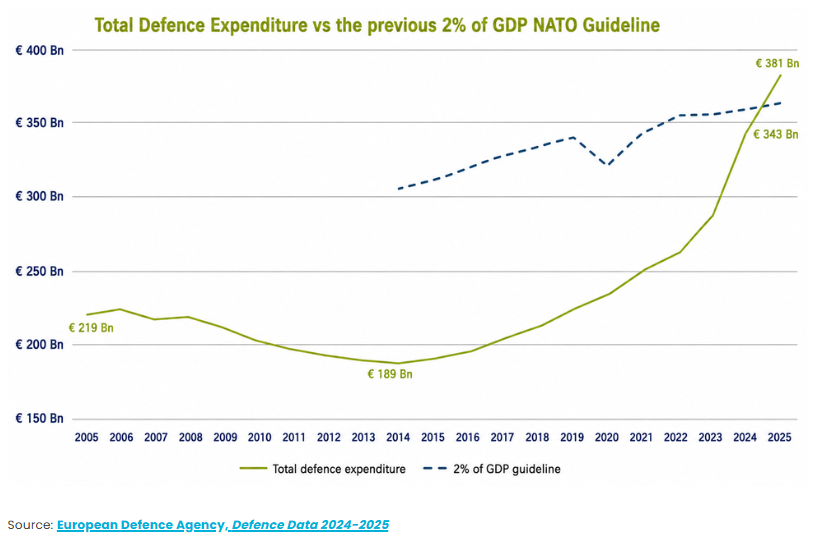
The July 2026 NATO summit in Ankara reinforced a shift that has been underway since the invasion in 2022: Europe’s defence effort is no longer a temporary spending cycle but a structural, multi-decade industrial commitment. As the United States is gradually reducing its role in the continent’s conventional defence, the key question is how quickly can Europe translate higher defence budgets into military capabilities, industrials capacity and strategic autonomy. As the chart shows, NATO spending has long been behind the 2% GDP guideline, only exceeding it for the first time in 2025.
For investors, several long-duration cycles are emerging, each with different potential beneficiaries. Identifying them requires looking beyond spending targets to the companies capable of delivering.
For more details, click here
Ken Van Weyenberg
Head of Client Portfolio Management Equity
Ken Van Weyenberg has been Head of Client Portfolio Management Fundamental Equity since 2025. Since joining Candriam in 2010, his previous roles have included Senior Client Portfolio Manager for Thematic Global Equity, Head of Client Portfolio Management for Private Clients & Asset Allocation, and Senior Investment Specialist in Private Clients & Asset Allocation.
Before joining the asset management industry, Ken spent three years in media and financial journalism at Kanaal Z/Canal Z and Moneytalk & Cash.
Ken holds a Bachelor’s in Journalism from Artevelde Hogeschool Gent, Belgium.

Quentin Duquesne, CFA, CAIA
European Equity Analyst – Fund Manager
Quentin Duquesne is an Equity Analyst and Fund Manager within Candriam’s European Equity team. He focuses on the Aerospace and Defence sectors and contributes to the management and co-management of European equity funds through bottom-up portfolio construction, company research and valuation analysis.
He joined Candriam in 2015 and has held several roles within the firm, including Reporting Officer in the Assets & Flows team and Market Intelligence Analyst within Investment Solutions. He later became a Research Equity Analyst covering European equities before being promoted to his current Fund Manager role in 2026.
Quentin holds a master’s degree in management (Finance) from IÉSEG School of Management and completed an MBA in Business in Asia at National Chengchi University. He is both a CFA and CAIA Charterholder.